
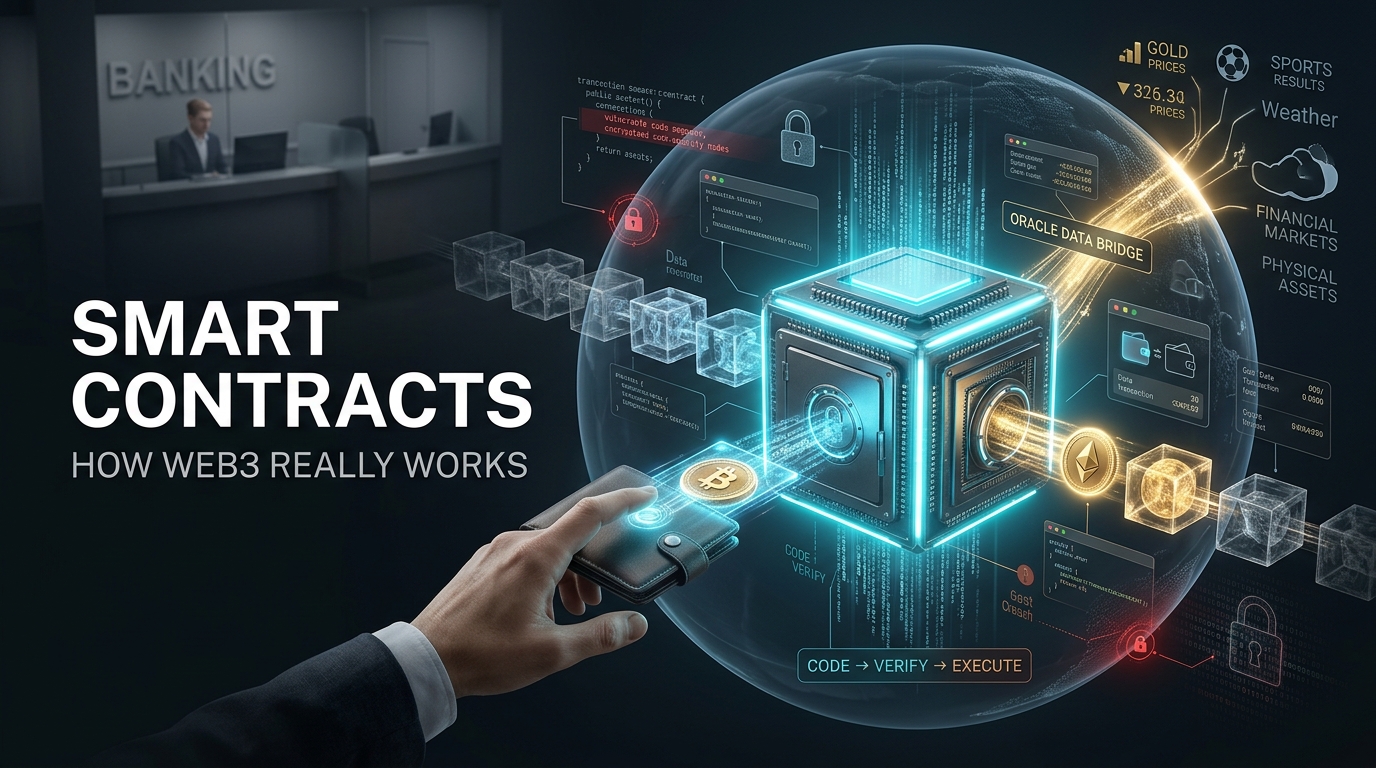
As of Saturday, July 18, 2026, automated computer code manages billions of dollars of global wealth. No human intermediaries are involved. None at all. This silent network operates continuously, executing transactions in fractions of a second. Yet, the core concept remains widely misunderstood. How can we trust our digital assets to code that has no feelings?
When programmable blockchains first emerged, excitement was electric. The concept promised to eliminate greedy middlemen. It would cut transaction costs to pennies. A neutral financial system was born. And honestly, that excitement made complete sense. Our traditional banking systems are slow. They are incredibly expensive. A self-operating network felt like pure magic.
The Digital Vending Machine
But what exactly is this technology? To understand it, forget paper documents. There are no lawyers here. Instead, these are digital programs. They are stored on a blockchain ledger.
Let's use a simple real-world analogy. Think of a vending machine.
You insert a coin. You press a button. The machine drops your soda.
You do not need a shop assistant. You do not negotiate terms. The rules are pre-programmed into the machine. If the conditions are met, the transaction happens.
According to CoinGecko educational data, smart contracts function exactly like this. But they do it on a global scale. Instead of dispensing soda, they handle assets. They manage digital loans. They transfer property deeds. They distribute musical royalties instantly.
The rules are written in code. The ledger keeps them secure.
Once deployed, they cannot be stopped. No bank can freeze them. No politician can rewrite the terms. This creates absolute predictability.
Yet, this predictability can be highly dangerous. Humans use common sense during disputes. If a physical contract has a typo, judges fix it. But code has no common sense. There is no judge. The software will execute the error perfectly, even if you lose everything.
How Smart Contracts are Created
How do these digital machines get built? Developers write them using specialized programming languages. On Ethereum, they use Solidity. On other networks, they might use Rust. These languages are designed for precision. Every line of code must be perfect.
Once written, the code is compiled. This means it is translated into a machine-readable format. Then, the developer deploys it to the blockchain. This process requires a small fee. Once it is on the ledger, it receives a unique address. Anyone can now interact with it.
But who pays for the computer power? Every time a contract executes, it uses network resources. The user initiating the transaction pays a small fee. This fee rewards the computer networks that maintain the blockchain. Without these fees, the network would grind to a halt.
Navigating the Practical Risks
So what does this mean for my portfolio? How do I actually interact with these digital machines safely?
For the average observer, smart contracts are the invisible gears turning behind the scenes. Every time you use a decentralized application, you are trusting a smart contract. But you must ask yourself: is the code you are interacting with actually secure?

The reality is that anyone can write and deploy a contract. There is no central gatekeeper checking the quality of the software. This means that poorly written contracts are common. If a contract has a loophole, hackers will find it. They will exploit it ruthlessly.
For a deeper look into how this connects to real market impact, this breakdown is worth your time: DeFi's Silent Revolution: Building the Foundations of a New Financial Epoch
Once your funds are sent to a flawed contract, they are often gone forever. To protect yourself, you must learn to check for third-party security audits. Established projects pay specialized firms to hunt for bugs in their code. While an audit does not guarantee absolute safety, it significantly lowers the risk of catastrophic failure. Always look for audit badges before interacting with a new platform.
The Blind Spot of the Blockchain
But here's the uncomfortable truth. Smart contracts are actually completely blind to the real world.
By design, a blockchain is a closed loop. It can only see data that exists directly on its own network. It has no native way to know who won the soccer match, what the price of gold is, or if a physical shipment arrived at a warehouse.
To bridge this gap, developers rely on specialized tools called oracles. Oracles are data feeds that translate real-world information into a format the contract can understand. Without them, programmable money would remain highly limited.
However, relying on oracles introduces a massive security bottleneck. If a hacker can corrupt the oracle's data, they can trick the smart contract. The contract will blindly execute based on the fake data it receives.
According to CoinTelegraph reports, oracle manipulation remains one of the most common vectors for major Web3 exploits. Security is only as strong as its weakest link. If the data source is weak, the entire system collapses.
For a deeper look into how this connects to real market impact, this breakdown is worth your time: Understanding Blockchain Oracles: How Smart Contracts Connect to the Real World
Here's the thing most people are missing. A smart contract is not actually smart. It is completely dumb. It only does exactly what it is told to do. If it is fed bad data, it will execute bad actions with perfect efficiency.
The Coin View Take
We believe that smart contracts are the most revolutionary advancement in financial coordination since the invention of double-entry bookkeeping. They remove the need for expensive, slow-moving middlemen. In our view, the world is moving toward a future where trust is commoditized. You will not need to trust a bank's reputation when you can verify the open-source code yourself.
Our team has been tracking these developments since 2017, and we have seen the brutal consequences of poorly tested software. We have watched millions of dollars vanish in minutes due to simple coding oversights. That is why we refuse to hype this technology as a flawless solution. It is still in its experimental phase.
What we are watching closely is the rise of formal verification. This is a mathematical process that proves a contract's code is entirely free of bugs before it goes live. In our view, this rigorous standard must become the industry default. Until then, users must remain highly vigilant. Do not risk more than you can afford to lose on unproven code.
The Macro Shift in Digital Wealth
Zooming out, the rise of programmable code has completely reshaped the structure of digital asset markets. We have transitioned from simple speculative assets into a highly complex global economy. In previous cycles, networks were valued purely on narrative. Today, they are valued on the actual activity running through their automated systems. Now whether this is realistic is a completely different conversation, but the fundamental utility being generated here is impossible to ignore.
The Rule of the Digital Jungle
Because in crypto, code is absolute law. There are no bailouts. There are no friendly bank managers to reverse your transactions. The market rewards those who take the time to learn the rules of the system, while punishing those who chase quick profits without understanding the underlying risks. True decentralization requires a trade-off: absolute freedom in exchange for absolute personal responsibility.
As we look toward the horizon, the line between software development and legal counsel will continue to blur. We are witnessing the very early stages of a completely automated financial layer for the internet. The infrastructure is being built, the code is running, and the future is yours to navigate.
✍️ About The Coin View Team
The Coin View Team is a group of independent crypto analysts and writers dedicated to cutting through the noise of the digital asset industry. We cover Bitcoin, blockchain technology, DeFi, and the future of money — with no hype, no fear tactics, and no financial agenda. Just the real story. Follow us on X (Twitter) for daily crypto insights.
⚠️ Disclaimer: The content published on The Coin View is for informational and educational purposes only. It does not constitute financial advice, investment advice, or a recommendation to buy or sell any cryptocurrency or digital asset. Cryptocurrency markets are highly volatile and unpredictable. Past performance does not guarantee future results. Always conduct your own research and consult a qualified financial advisor before making any investment decisions. — The Coin View Team, thecoinview.com
Post a Comment