
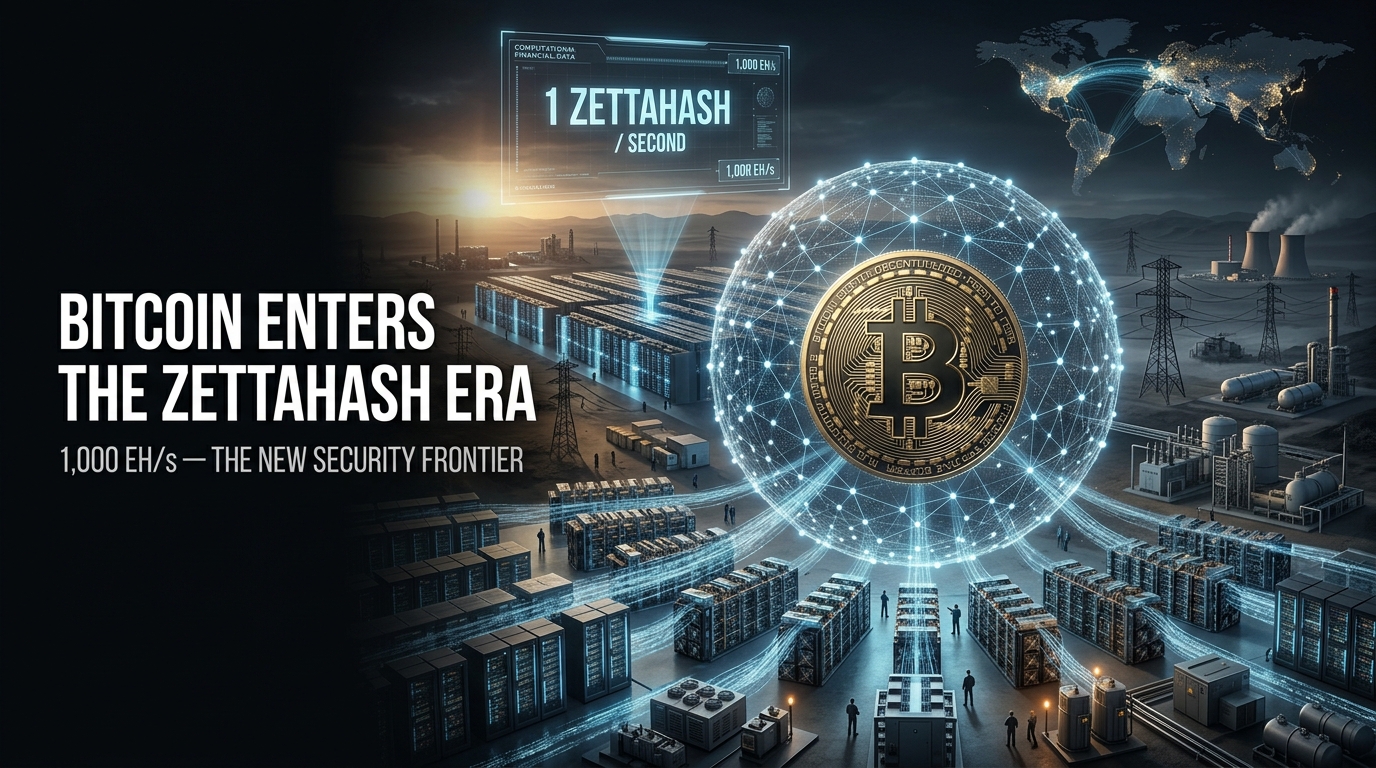
As of Friday, July 17, 2026, the computational shield protecting the world’s oldest cryptocurrency has done the unthinkable. In the late 2025, the Bitcoin network officially crossed a hashrate of 1,000 exahashes per second—entering the mythical "Zettahash Era" for the first time in history. Millions of mining machines worldwide have united to erect an overnight wall of security so dense that breaching it would require more energy than entire industrialized nations consume in a year. How did an asset once dismissed as a toy for cyber-punks transform into the most heavily fortified network on earth? Is this massive surge in processing power a sign of ultimate health, or are we witnessing the final consolidation of an industry under corporate control?
For years, the narrative surrounding the halving cycles was filled with existential dread. Analysts and retail investors alike feared that cutting mining rewards would trigger a death spiral. The theory was simple: as revenue dropped, miners would unplug their rigs, leaving the network wide open to malicious attacks. And honestly, that excitement and anxiety made complete sense. If you watched your core revenue source get slashed by 50% overnight, your immediate reaction would be to cut your losses.
The Path to 1 Zettahash: How the Record Fell
Yet, the absolute opposite happened. Instead of a mass collapse, the mining sector experienced a brutal, Darwinian upgrade cycle. According to Glassnode on-chain analytics, the network's processing power didn't contract; it scaled aggressively. To put this milestone into perspective, one zettahash represents one sextillion hashes per second. That is a one followed by twenty-one zeros. It is a number so vast that it exceeds the total grains of sand on all the beaches of Earth. If every person on Earth were to perform one calculation per second, it would take our entire global population several thousand years to match what this decentralized supercomputer performs in a single second. The scale is simply mind-boggling.
The mechanical explanation for this record lies in the rapid rollout of next-generation hardware. Mining firms spent the last two years aggressively retiring legacy machines. They replaced them with ultra-efficient, custom-designed 3-nanometer silicon chips.
But hardware efficiency is only half the story. The true catalyst for this record-breaking milestone is the complete overhaul of energy sourcing. Large-scale public operators have successfully decoupled themselves from traditional, volatile electrical grids. They are now deeply integrated into the energy sector itself.
Miners are actively purchasing stranded natural gas directly at the wellhead. They are partnering with municipal waste facilities to capture off-grid methane. Some have even built dedicated infrastructure directly adjacent to nuclear power plants. This means their cost of power has plummeted to near-zero levels. When your input energy costs are virtually nonexistent, your machines stay on. They remain profitable even under intense network difficulty adjustments.
Is This Record-Breaking Security Actually Good for You?
So what does this mean for my portfolio? Did I miss the boat on the ultimate institutional accumulation phase? Is this actually good news for the average retail holder?
Let us give you some direct clarity. This record does not mean the price of Bitcoin will double tomorrow morning. Hashrate is a lagging indicator of network health and capital commitment, not a leading indicator of speculative retail hype. What it does tell you is that the floor under this asset has never been more solid.
For a deeper look into how this connects to real market impact, this breakdown is worth your time: Bitcoin Spot ETFs Reshape Crypto Market Dynamics: A Price Outlook
When institutions deploy billions of dollars into physical, multi-year energy infrastructure, they are not planning to exit their positions next month. They are playing a multi-decade game of capital preservation. They are building a physical moat around their digital gold. This record proves that the world's largest liquidity providers have made their choice. They are here to stay.
The noise is loud. The volatility is real. But the math does not lie. Capital does not lie. This is not a temporary trend. This is a permanent migration.
But here's the uncomfortable truth most people are missing. This historic Zettahash milestone marks the official death of decentralized mining. Bloomberg Crypto recently reported that over 75% of the global hashrate is now controlled by a tiny handful of publicly traded corporate entities. The romantic vision of the sovereign individual securing the network with a spare GPU in their basement is gone. It is never coming back.
We have transitioned into a world of hyper-industrialized, state-aligned corporate mining. These massive enterprises operate with the blessing of regional governments. They utilize institutional credit lines to survive market downturns. This means the security of the network is now inextricably linked to the whims of corporate boardrooms and traditional Wall Street fund managers. They must answer to shareholders, ESG mandates, and federal regulators. When those pressures clash with the open-source ethos of decentralization, which side will win?
For a deeper look into how this connects to real market impact, this breakdown is worth your time: Bitcoin ETF Record: How BlackRock IBIT Shattered Financial History
This is the paradox of maturation. To achieve the level of security required to back global commerce, the network had to sacrifice its amateur roots. It had to grow up.
The Coin View Take
We think this 1 Zettahash milestone is the ultimate validation of Bitcoin's security architecture. For over a decade, academic critics insisted that the protocol's declining block subsidy would eventually lead to a security collapse. In our view, the reality we are observing today completely debunks that theory. The market has proven that as block rewards diminish, the value of transaction fees and the sheer utility of the network can comfortably incentivize industrial-scale capital commitment. Our read on this is that security is an emergent property of economic confidence. As confidence grows, the physical walls protecting the network grow taller.
What we are watching closely, however, is the geopolitical fallout of this milestone. A network secured by a Zettahash of computing power is no longer just a financial ledger. It is a highly strategic, sovereign-grade computational resource. In our view, we are rapidly approaching a point where nation-states will begin to view hashrate dominance as a matter of national security. Governments will likely start hoarding hashpower much like they hoard gold reserves or strategic oil reserves today. Some are already doing it quietly. This is no longer a localized corporate trend. It is a global race for computational sovereignty.
But we must also remain grounded. This level of institutional centralization creates new, unprecedented vectors of regulatory capture. If a small group of public corporations controls the vast majority of the block production, they are highly vulnerable to government coercion. We believe the developer community must double down on privacy protocols and decentralized mining pool alternatives. Without these technical safeguards, the censorship resistance of the network could be subtly eroded from the top down. We cannot afford to trade censorship resistance for raw physical security.
The Geopolitical Chessboard of Sovereign Security
Looking at the broader market, this historic milestone signals a permanent shift in how digital assets are perceived by global sovereign entities. When the security of a decentralized network surpasses the defense budgets of small nations, it stops being a speculative vehicle and starts being recognized as systemically critical global infrastructure. Our view is that this record forces a complete reassessment of risk. Asset managers can no longer treat this asset class as a highly speculative tech stock. It has become a core macroeconomic asset class. Now whether this is realistic to maintain indefinitely through future halvings is a completely different conversation. But for this cycle, the physical foundation has never been sturdier.
Because in crypto, the physical reality of code and infrastructure will always outlast the noise of the daily price charts. The market rewards those who look past the short-term volatility and focus on the compounding strength of the underlying network. It rewards those who understand that value is built on trust, and trust is built on hard, physical work.
The zettahash era is officially here, and the global network has never been more secure. What started in a small cryptography forum has now become a permanent, unassailable fixture of global finance. As we look to the horizon, the only remaining question is how fast the rest of the world will adapt. The market rewards adaptation.
✍️ About The Coin View Team
The Coin View Team is a group of independent crypto analysts and writers dedicated to cutting through the noise of the digital asset industry. We cover Bitcoin, blockchain technology, DeFi, and the future of money — with no hype, no fear tactics, and no financial agenda. Just the real story. Follow us on X (Twitter) for daily crypto insights.
⚠️ Disclaimer: The content published on The Coin View is for informational and educational purposes only. It does not constitute financial advice, investment advice, or a recommendation to buy or sell any cryptocurrency or digital asset. Cryptocurrency markets are highly volatile and unpredictable. Past performance does not guarantee future results. Always conduct your own research and consult a qualified financial advisor before making any investment decisions. — The Coin View Team, thecoinview.com
Post a Comment