
As of Sunday, July 19, 2026, billions of dollars are quietly flowing into crypto wallets worldwide without a single asset being traded. For years, this invisible engine has powered entire blockchains, turning ordinary token holders into passive earners overnight and changing how we view wealth creation forever. But where does this digital yield actually come from, and is it as secure as it seems?
When Proof of Stake (PoS) became the dominant consensus model, earning yield just for holding crypto felt like magic. No expensive mining rigs. No massive electricity bills. Just pure, passive accumulation. And honestly, that excitement made complete sense. Who wouldn't want to beat traditional bank rates of under 1% when decentralized networks are promising several times that amount?
Let's break down the mechanics. Many investors mistakenly view staking rewards as traditional bank interest. This is a critical error. In a traditional bank, your savings yield comes from the bank lending your money to others. Staking rewards are fundamentally different. They are system-level payments. The network programmatically mints new tokens to reward users who lock up their capital to secure the ledger.
According to CoinGecko data, the average yield for major PoS networks hovers between 3% and 8% annually. These rewards are paid out in the network's native token. This means their actual fiat value fluctuates constantly. If a network inflates its supply too quickly to pay high rewards, the value of each individual token dilutes. It is a balancing act. The network must incentivize security without destroying the token's long-term purchasing power.
So what does this mean for your portfolio? Is this passive income actually sustainable, or are you just inflating away your own capital?
The short answer is that staking rewards are real, but they are not free money. When you stake, you participate in network security. You take on lock-up risk, validator risk, and price volatility. If the underlying token drops by 50%, your 5% staking yield will not save your portfolio. However, if you are a long-term believer in a specific ecosystem, staking is the only logical path. It prevents your holdings from being diluted by the network's natural inflation.
But here's the uncomfortable truth. Not all staking rewards are created equal, and many platforms use complex engineering to hide the true source of their yields. Some protocols do not generate yield from network consensus at all. Instead, they rely on risky lending pools or speculative leverage.
Chainalysis data reveals that during market downturns, projects offering unsustainably high yields often collapse first. They lack the network-level utility to sustain those payouts. True staking rewards are tied directly to network activity and transaction fees, not speculative lending. When transaction volume drops, the real yield of a healthy network should adjust organically.
How Staking Rewards Actually Work
To understand staking rewards, we must understand how networks secure their data. In a Proof of Stake network, validators are responsible for checking transactions and adding them to the blockchain ledger. To become a validator, a node must lock up a specific amount of cryptocurrency as collateral. This is called the "stake." This stake acts as a security deposit.
If a validator behaves honestly, they receive a share of the network's block rewards and transaction fees. If they attempt to cheat or go offline for extended periods, they face "slashing." This is a process where a portion of their staked tokens is permanently taken away.
For a deeper look into how this connects to real market impact, this breakdown is worth your time: Blockchain Consensus Mechanisms Explained: How Networks Agree on Trust
Most retail users do not run their own validator nodes. It requires technical expertise and constant uptime. Instead, they use "delegated staking." This allows you to delegate your tokens to a professional validator. The validator does the heavy lifting, takes a small commission, and passes the remaining rewards to you. This lowers the barrier to entry, allowing anyone with a few tokens to participate.
The Balance of Power: Validators and Delegators
Validators operate the actual computers. They maintain the network. But they need weight behind their voice. That is where delegators come in.
By delegating your tokens, you give that validator more voting power. You are saying, "I trust this validator to be honest." This trust is not purely ideological. It is financial. If the validator performs well, you both win. If the validator goes offline, you both lose out on rewards. It is a shared risk profile that keeps the network decentralized.
The Fuel Source: Inflation and Fees
Where do the actual tokens come from? There are two primary sources.
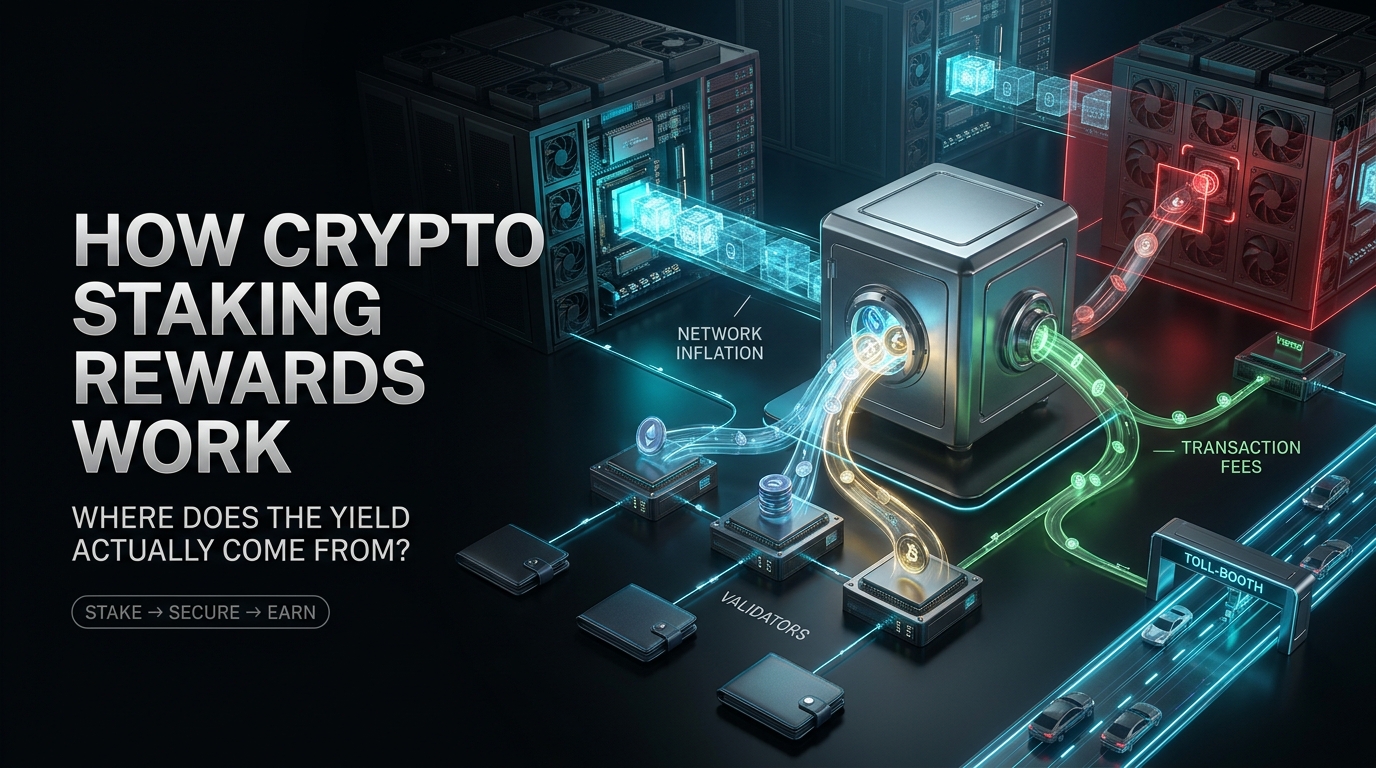
First, we have network inflation. The blockchain programmatically creates new tokens. It distributes them to validators on a set schedule. This ensures a baseline level of rewards even when the network is quiet.
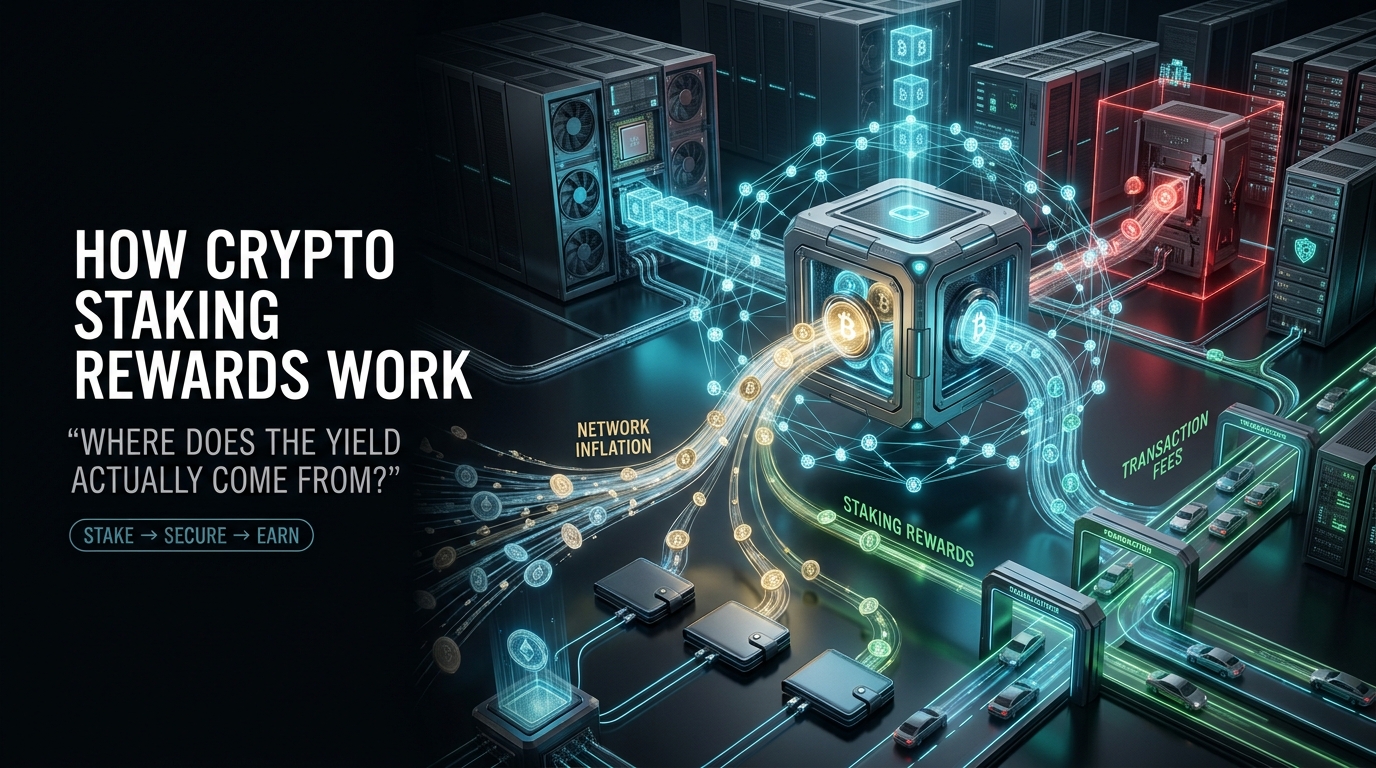
Second, we have transaction fees. Every time a user sends a transaction or interacts with a contract, they pay a fee. Part of this fee is given directly to validators. In highly active networks, transaction fees can make up a significant portion of the total staking rewards. This is the ultimate goal: transitioning from inflationary rewards to fee-driven rewards.
The Real-World Mechanics: A Simple Analogy
Think of a Proof of Stake network as a decentralized toll booth system. The highway represents the blockchain. The toll booths are the validators.
To get the job of running a toll booth, you must deposit a large sum of money with the city. This deposit is your stake. It guarantees your good behavior.
When cars drive through, they pay a toll. If you process the cars quickly and honestly, you keep a portion of the tolls. The city also prints a few new dollars to reward you for keeping the traffic moving.
If you fall asleep at the booth or try to steal, the city confiscates your deposit. It is a self-policing system.
This system works beautifully when traffic is high. But what happens when the road is empty? That is when the system relies heavily on inflation—minting new tokens to pay the toll booth operators.
For a deeper look into how this connects to real market impact, this breakdown is worth your time: Liquid Restaking Crypto Explained: The New Way to Multiply Ethereum Yields
The Coin View Take
We have been watching these consensus models evolve since we started tracking digital assets in 2017. In our view, staking is the single most important development for long-term retail accumulation in crypto history. It levels the playing field. In the old mining era, only those with cheap electricity and industrial hardware could profit. Now, the network rewards you simply for your commitment.
However, we think the industry has a major transparency problem regarding yield. Many projects advertise double-digit or even triple-digit staking rewards to attract speculative capital. This is a trap. These high yields are almost always funded by hyper-inflationary tokenomics. The nominal gains are quickly wiped out by market dilution. Our read on this is simple: if a staking yield looks too good to be true, you are the exit liquidity.
We advocate for a disciplined, risk-managed approach to staking. Stick to blue-chip networks where the yield is supported by real transaction fees and genuine developer activity. Do not chase paper gains on obscure protocols. The market rewards patience, but it brutally punishes greed.
Why Staking Rewards Matter to You
As a crypto participant, you cannot afford to ignore staking. If you hold a Proof of Stake asset and choose not to stake it, you are actively losing purchasing power. You are letting the network's natural inflation dilute your share of the total supply.
Think of it as a shareholder who refuses to accept dividend payments. You are taking all the risk of asset price volatility without receiving the compensation designed to offset it. Staking is not an extra bonus. It is a fundamental mechanism to preserve your equity in the network.
Of course, you must manage the liquidity tradeoff. Locking up your tokens means you cannot sell them instantly during a market crash. You must weigh the benefit of the yield against the flexibility of liquid cash.
As we look at the broader crypto market, the maturation of staking yields is shifting digital assets from highly speculative instruments to productive assets. This transition is essential for institutional adoption. Wall Street understands yield. They understand cash flow. By structuring staking as a predictable, protocol-native yield, the crypto market is building a decentralized alternative to the sovereign debt market. Now whether this is realistic to replace traditional treasury bonds entirely is a completely different conversation. But the foundation is processing.
Because in crypto, there is no such thing as a free lunch. Every percentage point of yield represents risk that you are carrying on behalf of the network. If you do not understand where that risk lies, you are the one bearing the cost. The market rewards adaptation, and understanding the core mechanics of how your assets generate value is the first step toward long-term survival in this space.
The future of decentralized yield is being built right now, block by block. As networks become more efficient and transaction volume grows, the relationship between capital and security will only deepen. By mastering these fundamentals today, you place yourself ahead of the curve, ready to navigate the next wave of financial innovation with confidence.
Key Takeaways
Rewards are system payments, not interest: Staking rewards are freshly minted tokens and transaction fees distributed to security providers, not interest paid on a loan. Inflation vs. real yield: High yields often signal high token inflation. Real sustainable yield is driven by actual network transaction fees and utility. The threat of slashing: Staking is not risk-free. Validators can be penalized (slashed) for bad behavior or prolonged downtime, which directly affects delegated funds. Stick to utility over hype: Long-term success in staking requires choosing established networks with real-world usage rather than chasing unsustainable promotional yields.✍️ About The Coin View Team
The Coin View Team is a group of independent crypto analysts and writers dedicated to cutting through the noise of the digital asset industry. We cover Bitcoin, blockchain technology, DeFi, and the future of money — with no hype, no fear tactics, and no financial agenda. Just the real story. Follow us on X (Twitter) for daily crypto insights.
⚠️ Disclaimer: The content published on The Coin View is for informational and educational purposes only. It does not constitute financial advice, investment advice, or a recommendation to buy or sell any cryptocurrency or digital asset. Cryptocurrency markets are highly volatile and unpredictable. Past performance does not guarantee future results. Always conduct your own research and consult a qualified financial advisor before making any investment decisions. — The Coin View Team, thecoinview.com
Post a Comment