
As of Friday, July 24, 2026, millions of dollars are shifting through decentralized lending protocols without a single bank manager signing a piece of paper. Entire fortunes are locked, borrowed against, or liquidated overnight by cold, unfeeling lines of code. How can a financial system safely hand out billions in loans to anonymous strangers without ever checking a credit score?
For years, the idea of peer-to-peer banking felt like an idealistic dream. We all wanted a world where you didn't have to beg a legacy bank for permission to access capital. And honestly, that excitement made complete sense. Who wouldn't want to bypass the endless paperwork, high fees, and gatekeepers of traditional finance?
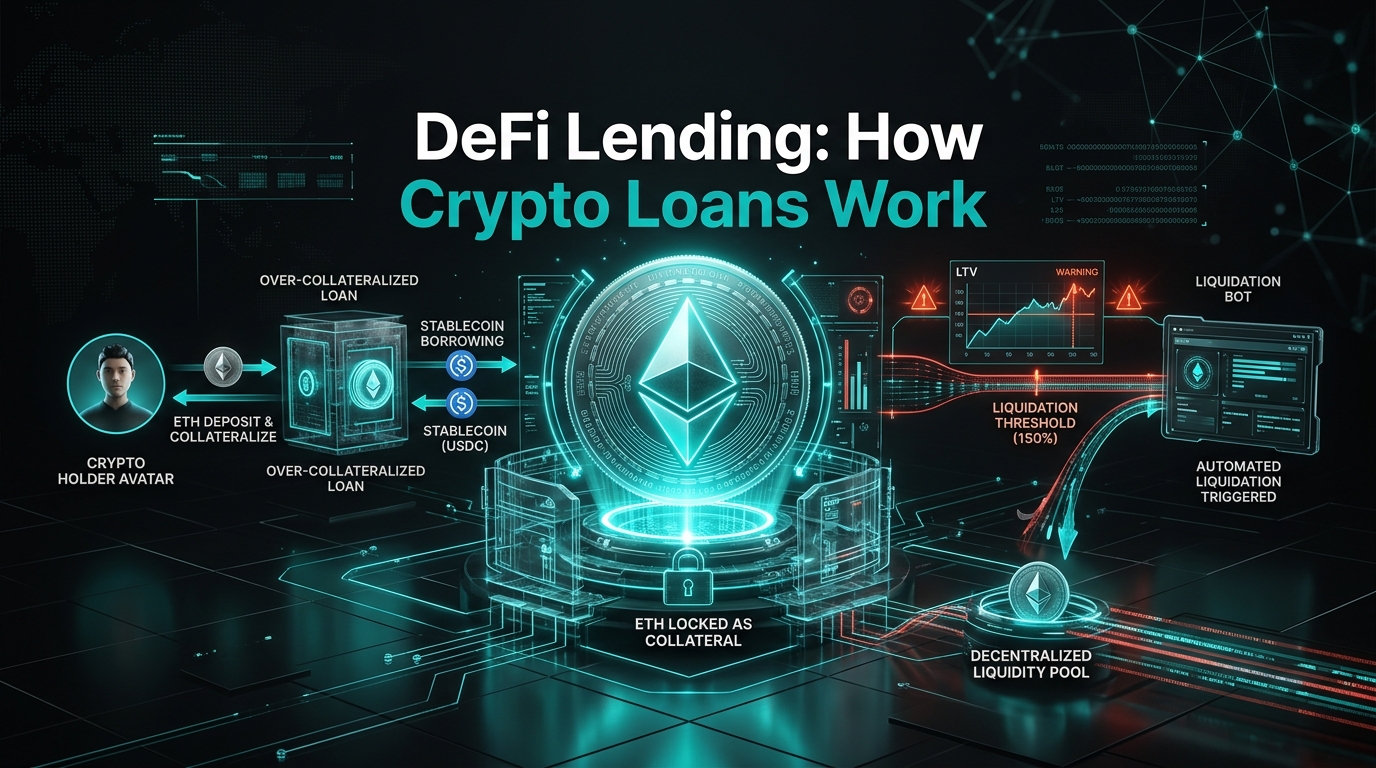
But to understand how this ecosystem functions, we must look at the mechanics under the hood. Traditional banks use credit scores and physical audits to trust you. DeFi protocols cannot do this because they do not know who you are. Instead, they rely on a mechanism called over-collateralization. If you want to borrow $100 in a stablecoin, you must first deposit perhaps $150 worth of another asset, like Ethereum, as a digital security deposit.
According to CoinGecko data, this simple design has locked tens of billions of dollars in smart contracts across major lending markets. This collateral acts as a safety net. If you fail to repay the loan, or if the value of your collateral drops too low, the protocol automatically sells your deposit to cover the debt. It is a completely automated process driven by smart contracts, meaning there is no human negotiation, no extensions, and no mercy.
This sounds incredibly rigid. So, what does this mean for my portfolio? Why would anyone lock up $150 just to borrow $100?
It seems counterintuitive at first. But for active crypto users, it is a powerful tool. Imagine you hold Ethereum. You expect its price to rise over the next year. You do not want to sell it because that triggers a tax event. By using a DeFi lending protocol, you can unlock liquidity without losing your upside potential. You get cash to spend today while keeping your crypto investment intact.
But here's the uncomfortable truth. This entire system depends on a volatile equilibrium that can collapse in minutes during market crashes. When the price of your collateral drops rapidly, you enter the danger zone. If your collateral ratio falls below a specific threshold, third-party bots called liquidators will instantly buy your collateral at a discount and pay off your debt.
This is not a rare occurrence. Bloomberg Crypto reported that during major market pullbacks, automated liquidations spike to hundreds of millions of dollars within hours. Casual retail users often do not realize how fast these bots operate. They scan the blockchain constantly, waiting to trigger a liquidation the exact second a price feed dips. You do not get a warning email or a friendly phone call; your position is simply closed.
Understanding DeFi Lending: The Virtual Pawn Shop
To understand how this works, think of DeFi lending like a high-tech pawn shop.
Imagine you own a rare watch worth $1,000. You need $500 in cash, but do not want to sell your watch because you believe it will double in value next year. You take it to a pawn shop. The owner gives you $500 cash and holds your watch as collateral. If you return with the $500 plus interest, you get your watch back. If you run away, the shop owner simply sells your watch to recover their funds.
In DeFi, the watch is your Ethereum (ETH). The cash is a stablecoin like USDC. The pawn shop owner is a smart contract—a piece of code running on a blockchain. Because the pawn shop is run by software, it does not care about your credit history. It only cares about the current market value of your collateral.
How It Works: The Mechanics of DeFi Lending
Let us break down the exact steps that happen behind the scenes.
First are Liquidity Pools. These are giant smart-contract vaults where users deposit assets to earn interest. Borrowers pull from these pools to take out their loans.
Second is the Collateral Factor. The protocol assigns a "collateral factor" (expressed as a percentage) to each asset based on its volatility. For example, a blue-chip asset like ETH might have a collateral factor of 80%, allowing you to borrow up to $800 against $1,000 of ETH.
Third are Dynamic Interest Rates. When a lending pool is highly utilized, rates spike to encourage repayments and attract depositors. If the pool is mostly idle, rates drop to attract borrowers.
For a deeper look into how this connects to real market impact, this breakdown is worth your time: DeFi's Silent Revolution: Building the Foundations of a New Financial Epoch
A Real-World Example: The Life of a DeFi Loan
Imagine Sarah has 1 ETH, valued at $3,000. She wants cash but does not want to sell her ETH. She connects her wallet to a lending protocol.
Sarah deposits her 1 ETH. The protocol has a collateral factor of 75% for ETH, meaning she can borrow up to $2,250. To stay safe, she only borrows $1,500 in USDC (a 50% loan-to-value ratio).
Now, two scenarios can unfold: Scenario A: The price of ETH rises to $4,000. Sarah returns the $1,500 USDC plus interest. The protocol unlocks her 1 ETH, and she withdraws it safely. Scenario B: A sudden crash hits, and ETH drops to $1,900. Her LTV ratio spikes to 79%, passing the 75% threshold. An automated liquidation bot instantly pays off her $1,500 debt, takes her ETH, and sells it at a discount. Sarah keeps the borrowed USDC, but her ETH is gone.
Why This Matters to You
Why should an intermediate crypto participant care about these mechanics?
If you are yield farming, staking, or trading, lending protocols are the bedrock of your strategies. They allow you to leverage your positions safely. You can long an asset by depositing it, borrowing stablecoins, buying more of the asset, and depositing that too.
But it also multiplies your risk. If you do not understand the liquidation thresholds, you are playing with fire.
To see how these lending mechanics interact with decentralized trading platforms, read our guide on How Automated Market Makers Work: The Math Powering Decentralized Exchanges
The Coin View Take
We have been watching the evolution of decentralized credit markets since 2017. In our view, DeFi lending is one of the very few sectors in crypto with undeniable product-market fit. It works. It has survived multiple brutal bear markets without a central entity needing a government bailout. While traditional banks folded during historical crises, these automated code-based lending pools kept ticking.
However, we think too many educators gloss over the inherent risks of smart contract vulnerabilities and oracle failures. If the price feeds feed incorrect data to the protocol, healthy positions can get wiped out through no fault of the user. Our read on this is simple: DeFi lending is not a "set-and-forget" savings account. It is an active financial tool that requires constant monitoring and a deep understanding of risk thresholds.
What we find most interesting here is the shift toward under-collateralized lending for institutional players. While retail users must collateralize heavily, institutions are slowly building credit-reputation systems on-chain. We are watching this closely because it could bridge the gap between real-world finance and decentralized networks. But until that infrastructure matures, keep your collateral ratios safe and your eyes on the market.
The Bigger Leverage Picture
On a broader scale, decentralized lending acts as the foundational liquidity engine of Web3. When lending protocols thrive, capital flows more efficiently across decentralized exchanges, yield aggregators, and layer-2 networks. It creates a multiplier effect that powers entire bull markets. Now, whether this current pace of growth is sustainable without causing systemic leverage risks is a completely different conversation. But the infrastructure itself is here to stay, rewriting the rules of capital efficiency.
The Immutable Rule of Decentralized Debt
Because in crypto, code is both your ultimate protector and your most ruthless executioner. There are no friendly bank representatives to waive a fee or give you a grace period. If you do not manage your own risk, the smart contract will manage it for you, with absolute precision and no remorse. The market rewards preparation and punishes complacency.
As decentralized lending protocols grow more sophisticated, the boundary between traditional banking and self-custody will continue to blur. The tools to build your own personal bank are already sitting right in front of you. Understanding how to use them safely is the first step toward true financial autonomy.
Key Takeaways
DeFi Lending Relies on Collateral, Not Credit: Because blockchain transactions are anonymous, you must deposit more value (over-collateralization) than you borrow to secure the loan. Smart Contracts Enforce the Rules: Interest rates and loan health are managed entirely by automated code, adjusting dynamically based on supply and demand. Liquidation is Swift and Automated: If your collateral's value drops below a set threshold, third-party bots will instantly liquidate your assets to repay the debt, with no human intervention. It Unlocks Capital Efficiency: DeFi lending allows you to access liquidity against your assets without selling them, helping you defer taxes or leverage your market positions.✍️ About The Coin View Team
The Coin View Team is a group of independent crypto analysts and writers dedicated to cutting through the noise of the digital asset industry. We cover Bitcoin, blockchain technology, DeFi, and the future of money — with no hype, no fear tactics, and no financial agenda. Just the real story. Follow us on X (Twitter) for daily crypto insights.
⚠️ Disclaimer: The content published on The Coin View is for informational and educational purposes only. It does not constitute financial advice, investment advice, or a recommendation to buy or sell any cryptocurrency or digital asset. Cryptocurrency markets are highly volatile and unpredictable. Past performance does not guarantee future results. Always conduct your own research and consult a qualified financial advisor before making any investment decisions. — The Coin View Team, thecoinview.com
Post a Comment