
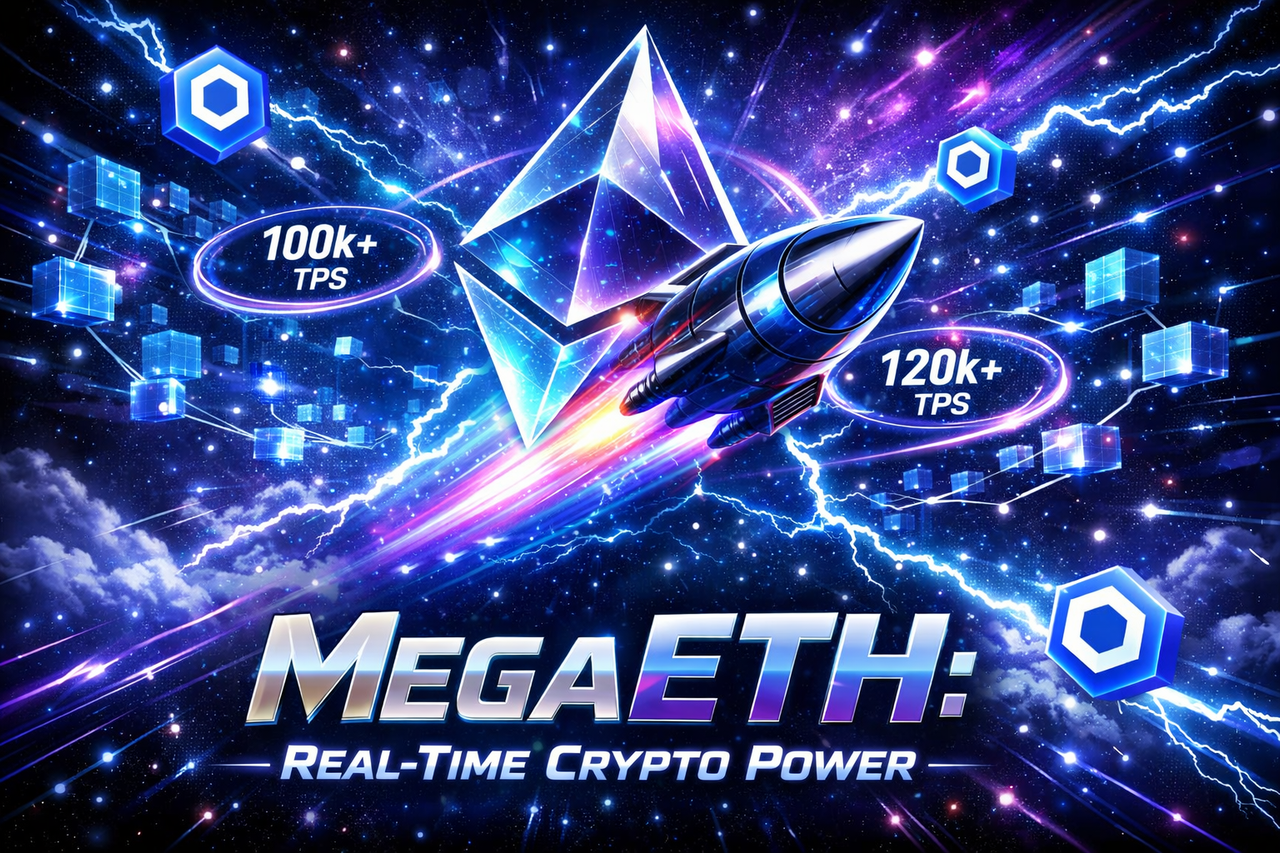
The Speed Demon of Crypto: In-Depth Review of MegaETH's Real-Time Blockchain
In the fast-evolving world of cryptocurrency, where speed and scalability often define success, MegaETH emerges as a game-changer. As an Ethereum Layer 2 solution, it promises to deliver real-time performance that could redefine how we interact with blockchain applications. With its token generation event (TGE) slated for January 2026, $MEGA is poised to capture attention amid growing institutional interest in high-performance blockchains. This review dives into what makes MegaETH stand out, its technical prowess, potential impacts, and why it's a trending topic for investors and developers alike.
MegaETH positions itself as the "first real-time blockchain," aiming to eliminate the bottlenecks that plague traditional Ethereum transactions. Built on Ethereum's security while enhancing its capabilities, it targets sub-millisecond latency and over 100,000 transactions per second (TPS)—figures that dwarf many current Layer 2 networks. Imagine trading on a decentralized exchange where price updates happen instantaneously, or gaming on-chain without lags that break immersion. That's the vision: turning crypto into a seamless, everyday tool rather than a clunky system.
At its core, MegaETH leverages innovative technologies to achieve this. One key feature is the SALT (Small Authentication Large Trie) architecture, which keeps authentication data in RAM to slash disk I/O, boosting efficiency. It also employs stateless validation via Pi Squared’s semantic validation, allowing even low-spec devices to verify transactions without compromising decentralization. This bridges the gap between high throughput and true decentralization, a holy grail in blockchain design. Additionally, MegaETH integrates Chainlink Data Streams natively through a precompile, enabling ultra-low latency oracle data for real-time DeFi applications. Partnerships like the one with Ethena introduce USDM, a stablecoin that aligns incentives for sequencers, potentially offering the lowest fees in the ecosystem.
The $MEGA token is central to this setup. While full tokenomics details are still unfolding post its introduction in October 2025, it's expected to serve multiple utilities. Primarily, $MEGA will likely be used for gas fees on the network, staking for security, and governance decisions. Early indications suggest a focus on community alignment, with a public sale already conducted via Sonar in late 2025. The total supply and distribution aren't fully public yet, but L2 tokens typically allocate portions to ecosystem development, liquidity providers, and early adopters. Rumors of an airdrop for testnet participants add to the hype, potentially rewarding those who engage early with the platform's beta mainnet, dubbed "Frontier."
The team behind MegaETH brings credibility to the project. Led by figures like Shuyao, who emphasizes real-time infrastructure, and Namik, focused on community-driven sales, the core group is supported by the "MegaMafia"—a global collective of builders in DeFi, gaming, and culture. This isn't just a tech play; it's a cultural movement, with co-living offsites fostering innovation. Advisors and early founders collaborate to build "net-new" apps that showcase MegaETH's speed, turning abstract tech into viral experiences.
Why is MegaETH trending in January 2026? The timing couldn't be better. As crypto markets hit a $3.02 trillion cap and institutional trends like tokenization and AI integration gain steam, high-performance L2s are in demand. MegaETH's mainnet launch aligns with this, promising to outpace competitors like Base in speed and scalability. Whales are eyeing similar assets, and listings on major exchanges like Coinbase (which added it to its roadmap) signal strong market interest. In a year where AI and real-world asset (RWA) tokenization are hot, MegaETH's real-time capabilities could supercharge these sectors—think instant AI-driven trades or tokenized assets settling in milliseconds.
From a user's perspective, I've dabbled in various L2s, and the frustration of waiting for confirmations during volatile markets is real. MegaETH could change that. Picture this: You're a DeFi trader spotting an arbitrage opportunity. On standard Ethereum, by the time your tx processes, the window's gone. With MegaETH's sub-10ms block times, you execute instantly, potentially multiplying gains. But it's not all upside—early adopters might face teething issues like network congestion during launch or dependency on Ethereum's base layer for security.
On the flip side, the project's emphasis on decentralization via stateless validation addresses scalability concerns without sacrificing ethos. It's EVM-compatible, so developers can port apps easily, fostering rapid ecosystem growth. The MegaMafia initiative is particularly exciting, inviting builders to create apps that turn behaviors into engaging, real-time experiences— from social games to predictive markets.
Potential risks? Like any new coin, volatility is expected post-TGE. Regulatory scrutiny on L2s could impact adoption, and competition from established players like Optimism or Arbitrum is fierce. However, MegaETH's focus on "extreme performance" sets it apart, targeting niches where speed is paramount.
In summary, MegaETH isn't just another L2—it's a bold step toward making blockchain feel instantaneous. With its January 2026 launch, $MEGA has strong SEO potential around terms like "real-time Ethereum" and "high-speed blockchain." For investors, it's a bet on the future of performant crypto infrastructure. If it delivers on promises, we could see widespread adoption, driving $MEGA's value through network effects. Whether you're a dev building the next big app or an investor seeking the next 10x, MegaETH warrants a close watch.
What is MegaETH?
MegaETH is an Ethereum Layer 2 blockchain focused on real-time performance, offering sub-millisecond latency and over 100,000 TPS for faster crypto applications.
When does $MEGA launch?
The token generation event (TGE) and mainnet are scheduled for January 2026, following testnet optimizations.
How can I buy $MEGA?
Post-TGE, it will likely be available on major exchanges like Coinbase, which has added it to its listing roadmap. Use wallets compatible with Ethereum L2s.
What makes MegaETH's SALT architecture unique?
SALT keeps authentication data in RAM, eliminating disk I/O bottlenecks for unprecedented speed, unlike traditional trie structures in other blockchains.
Is there an airdrop for MegaETH?
While not officially confirmed, testnet participants and early ecosystem contributors may qualify for rewards, based on similar L2 launches.
How does MegaETH integrate with AI?
Its real-time oracles via Chainlink enable instant data feeds, perfect for AI agents in DeFi or predictive markets, a niche growing in 2026.
What role does the MegaMafia play?
It's a builder collective co-creating apps on MegaETH, blending tech with culture through global offsites—think A24-style innovation in crypto.
Post a Comment